 |
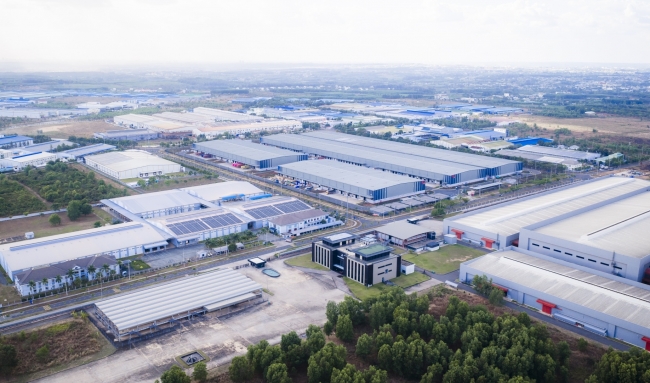
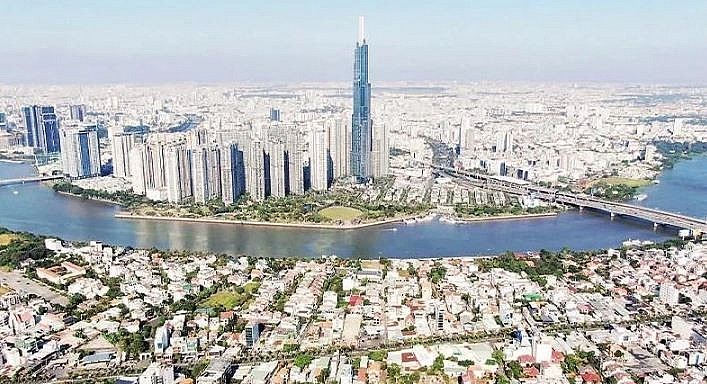
| A corner of Ho Chi Minh City seen from above (Photo: nhandan.vn) |
In this context, expanding development space and promoting the role of the private sector have become urgent needs, closely tied to the effective implementation of the Politburo’s Resolution No. 68-NQ/TW, dated May 4, 2025, on the development of the private sector.
The resolution affirms that in a socialist-oriented market economy, the private sector is one of the most important driving forces of the national economy. On that foundation, the upcoming mergence of Binh Duong and Ba Ria–Vung Tau provinces into Ho Chi Minh City will create conditions to form a mega-urban region integrating industry, finance, seaports, and innovation.
Within this development structure, the private sector is not only a core productive force but also a decisive factor in enhancing the competitiveness of the entire Southern Key Economic Region.
Ho Chi Minh City currently has more than 280,000 private enterprises, contributing about 70% of the gross regional development product (GRDP) and nearly 55% of total budget revenue.
Binh Duong, with more than 65,000 enterprises, is the leading locality in the country in terms of industrialisation and urbanisation, with nearly 80% of GRDP coming from the private sector.
Ba Ria-Vung Tau, despite its small population, also has nearly 17,000 private companies, accounting for more than 60% of GRDP, especially in the fields of seaports, logistics, and oil and gas services. In total, the three localities gather nearly 370,000 private enterprises, equivalent to 45% of the country, creating millions of jobs and contributing nearly 50% of the industrial production value of the entire southern region.
However, the large numbers do not reflect the quality and depth of development. Most enterprises are still small and micro-sized companies; and have low capital, and limited management and technology capacity. According to statistics, more than 94% of the enterprises in Ho Chi Minh City have charter capital of less than 10 billion VND (385,350 USD). The rate of enterprises applying high technology and meeting export standards is still low. These are also the bottlenecks pointed out by the Party Central Committee in Resolution No. 68.
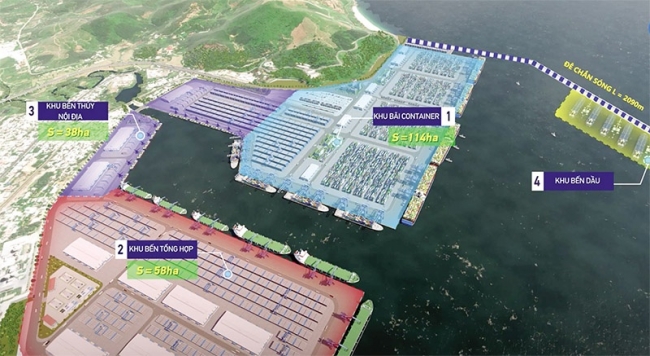
To overcome these limitations, a systematic regional development strategy is needed, in which the role of institutional and policy coordination between the localities plays a decisive role. Each locality has its own advantages, with Ho Chi Minh City being a financial centre and owning high-quality human resources; Binh Duong being a production "factory"; and Ba Ria-Vung Tau being an export terminal owning Cai Mep-Thi Vai deep-water port cluster. Closely linking these three development poles will form a closed value chain from research, production, logistics to international consumption, with the private economic sector at the centre.
Regional logistics infrastructure is also a vital factor. Key projects such as Ring Roads 3 and 4, Bien Hoa-Vung Tau expressway, along with the inland waterway and railway systems in the Southeastern region, need to be accelerated. At the same time, there is a need to build satellite industrial zones with ready-to-use infrastructure and flexible leasing mechanisms to enable small- and medium-sized enterprises (SMEs) to participate in value chains.
Special attention must be given to developing large-scale enterprises, as currently, the proportion of businesses with a charter capital of over 100 billion VND accounts for less than 5%. The establishment of an enterprise development fund for enterprises in the expanded Ho Chi Minh City region, with a scale of approximately 10 trillion VND from the counterpart funding and social sources, will be a practical solution to support the development of businesses involved in technology, smart manufacturing, high-tech agriculture, clean industries, and cross-border logistics.
From the perspective of digital transformation, Ho Chi Minh City leads the country in the proportion of businesses adopting new technologies, while the other two provinces still have significant room for growth. Therefore, the establishment of digital transformation centres in industrial zones, linked with universities and digital infrastructure, will create an environment that supports small businesses in developing new sectors such as e-commerce, fintech, and cross-border digital services.
To build a "growth triangle" that harnesses the strengths of Ho Chi Minh City, Binh Duong, and Ba Ria-Vung Tau, a long-term development strategy is required, with local private enterprises as the central axis. The role of the State is not to replace businesses, but to create conditions allowing them to grow healthily and in the right direction.
The expanded Ho Chi Minh City region is fully positioned to become a leading economic, innovative, industrial, and service hub in Southeast Asia. What is needed now is a strong policy push, a long-term action vision, and a deep belief in the potential of private enterprises. At that point, the regional-level mega-city will not just be a distant vision but will stand as a new symbol of Vietnam's independent and sustainable development in the 21st century./.