Expand autonomy from the local budget
In the period 2011-2016, 13 provinces and cities paid to the central budget, and 50 received balanced subsidies from the central Government because they could not balance their local budgets. Therefore, the change in this ratio will help share with disadvantaged localities and shorten the development gap between localities in the region.
According to decentralization, local budget revenue gradually grows in stages of both size and proportion. The number of localities with state budget revenues of more than 10,000 billion VND, 5,000 billion VND to less than 10,000 billion VND, and 1,000 billion VND to less than 5,000 billion VND has steadily increased over the years. In 2016, there were 15 localities (group of 10,000 billion VND), 11 localities (from 5,000 billion VND to under 10,000 billion VND), and 37 localities (from 1,000 billion VND to under 5,000 billion VND). By the end of 2020, there were 30 localities (group of 10,000 billion VND), 16 localities (from 5,000 billion VND to under 10,000 billion VND), and 16 localities (group of 10,000 billion VND).
 |
| Strive for a 5-7% increase in domestic revenue in 2024 |
In fact, in comparison with the period of budget stabilization from 2011 to 2015, the ratio of division between the central budget and the local budget has changed in the direction of increasing the rate of regulation for the central budget and decreasing the rate of division for the local budget. The National Assembly decreased the rate of allocation to the local budget of revenues divided between the central budget and the local budget for most provinces and cities with large state budget revenues, including two major cities in Vietnam, i.e. Hanoi and Ho Chi Minh City.
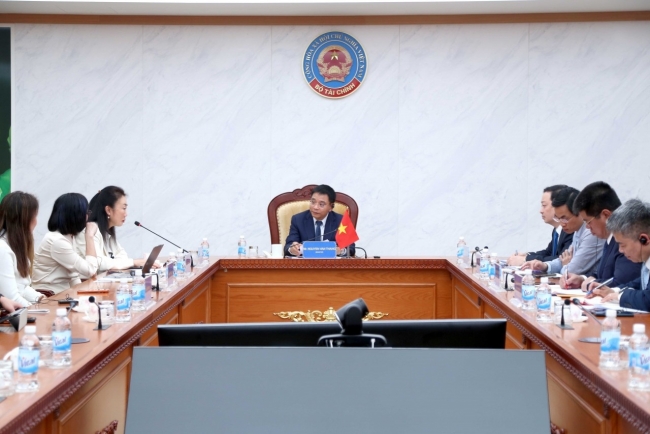
The Ministry of Finance (MoF) was assigned by the Government with developing a scheme to renovate the mechanism of the state budget management and allocation to ensure the central budget's leading role and the proactive and active role of the local budget, relevant agencies, and units, particularly the mechanism and policies to cultivate revenue sources.
Indeed, the central budget and local decentralization mechanisms have yielded numerous positive results over the past years. The decentralization of state budget management has ensured the mobilization and effective use of national financial resources. As a consequence, the National Assembly's real power has been guaranteed, and the People's Councils at all levels have taken more initiative in making the budget estimates, allocating funds, and approving the budget settlement.
As a result, it can be stated that the Law on the state budget has created a significant breakthrough in the formulation, implementation, and management of the budget, particularly by increasing the role and responsibility of local authorities at all levels in paying attention to, fostering, and exploiting revenues in the area.
Ensure the leading role of the central budget
However, the budget decentralization mechanism has so far had flaws and exposed risks. The central budget’s leading role has been lessened, leading to restricting the central budget’s capacity and orientation and reducing the state budget’s ability to definitively invest in key and breakthrough projects for the economy's development.
Furthermore, due to the scope of local authority resources, particularly for the 47 provinces and cities receiving additional supplements from the central budget, as well as the relatively specific decentralization mechanism (not divided by tax but divided by aggerate revenue in the area), local authorities role in deciding revenue sources and expenditure tasks has relatively limited. Meanwhile, central budget expenditure is on the decline, accounting for below half of aggerate state budget expenditure.
Experts have provided extensive feedback on this topic. Many economic experts believe that it is critical to study and modify the mechanism of revenue allocation - budget expenditure to ensure the central budget's leadership role, particularly in the current context. It is also suggested that some provisions of the state budget law on budget decentralization be studied and amended to strengthen the central budget's leading role, ensuring that the proportion of central budget revenue is around 60 - 65% of aggerate state budget revenue; the increase in revenue is only used to reduce the deficit and form revenues associated with expenditure tasks like education and health.
The MoF is currently working on a draft scheme to modernize the state budget management and allocation mechanism to ensure the central budget's leadership role as well as the local budget's initiative. The overall goal is to renew the decentralization and budget allocation mechanism in the direction of clearly delineating responsibilities and powers between the central and local levels, local authorities, the state and the market, the state budget and non-budget state financial funds, and the state budget and financial resources of public non-business units.
Simultaneously, it is essential to promote decentralization and decentralization associated with specific responsibilities, as well as strengthen inspection and supervision; ensure the leading role of the central budget, promote the autonomy and creativity of the state budget; stimulate the synergy of state financial resources, as well as take advantage of the potential and advantages of each region and locality, and maximize social resources to promote rapid and sustainable socio-economic development./.
| Adjustment to increase upper-level budget resources It is suggested that to further improve the management and decentralization of state budget management in the future, it is necessary to conduct thorough research before proceeding to eliminate the integration of the budget system. However, in the current context, it is vital to exercise caution before abolishing this mechanism to ensure the central government's centralized and unified management. In general, the central budget must continue to prioritize large and significant revenue sources. To proactively balance the budget, municipalities actively exploit and cultivate revenue sources associated with the local economy. According to the provisions of Clause 2, Article 40 of the State Budget Law, the percentage (%) of revenue sharing between budgets at all levels is determined in the first year of the new budget stabilization period, based on the state budget revenue estimate and the budget expenditure estimate (determined under the provisions of the system of principles, criteria, and norms for allocation of investment expenditures and regular expenditures of the state budget) At the same time, Clause 8, Article 9 of the State Budget Law also stipulates"After each period of budget stabilization, localities must increase their ability to balance themselves and develop the local budget to gradually reduce the proportion of balanced supplement from the upper-level budget compared to the aggerate local budget expenditure or increase the percentage (%) paid to the upper-level budget for revenues divided between budget levels to increase resources for the upper-level budget to perform national expenditure tasks and develop evenly between localities". The Standing Committee of the National Assembly has promulgated expenditure estimates for local budget balances in the years in terms of principles, criteria, and norms for allocation of recurrent state budget expenditure estimates and comply with regulations on principles, criteria, and norms for allocation of state budget public investment capital for the entire period 2021-2025. Regarding budget revenue, according to the provisions of the law on taxes, fees, and charges, and the expected level of socio-economic development in localities in 2023, the MoF has worked and agreed on the state budget revenue estimate in 2023 of the locality. The National Assembly passed Resolution No. 70/2022/QH15 on central budget allocation in 2023, which stipulates that "the percentage (%) of revenue sharing between the central budget and the budget of each province and municipal city, the balanced supplement has been applied to the budget stabilization period to 2025." ./. |