
Heineken to shift production from Singapore to Vietnam and Malaysia
Dutch brewer Heineken will shift its brewing production from Singapore to Vietnam and Malaysia as part of its strategy to build a more agile regional supply approach.

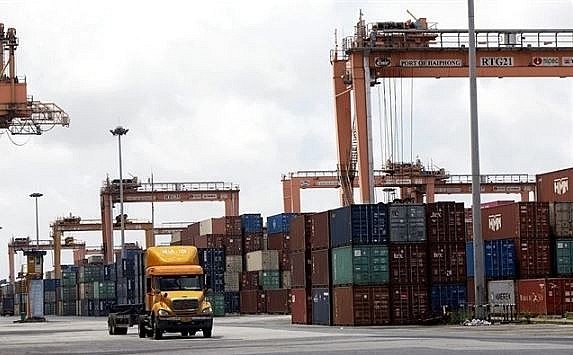 |
| Goods containers waiting for export at Tan Vu Port, Hai Phong city. (Photo: VNA) |
Despite escalating global uncertainties and the looming threat of reciprocal tariffs from the US, Vietnam remains committed to its ambitious GDP growth target of 8% for 2025.
This determination, highlighted in a resolution issued by the Government on April 10, reflects not only optimism but also a strategic readiness to absorb external shocks through coordinated and flexible policies.
Amid growing geopolitical tensions, trade disputes and supply chain disruptions, Vietnam is also contending with extreme weather events, inflation and exchange rate volatility. Nonetheless, the Government is calling on ministries, local authorities and businesses to stay optimistic, confront challenges head-on and seize emerging opportunities.
In particular, 37 provinces and cities that fell short of their Q1 growth targets have been directed to reassess their performance and revise strategies for the remainder of the year.
One of the gravest current concerns is the potential imposition of reciprocal tariffs by the US, with rates possibly reaching as high as 46%. Although Washington has granted a temporary 90-day reprieve, the urgency remains.
According to the National Statistics Office (NSO), Vietnam’s exports to the US were valued at 119.6 billion USD in 2024, making it the country’s largest export market and accounting for nearly 30% of total exports. The trade surplus with the US stood at 104.6 billion USD.
Given the significance of US trade as a key economic driver, any new tariffs could have serious consequences for Vietnam’s major export sectors and overall growth.
In response, the Ministry of Finance is preparing support packages for affected workers and businesses, including a proposed extension of VAT reductions from July 2025 through to the end of 2026. The State Bank of Vietnam is also planning to manage exchange rates flexibly and ensure access to credit for firms under pressure.
Phi Vinh Tuong, Deputy Director of the Institute of Vietnam and World Economy, said the politicisation of trade policy – particularly amid ongoing US–China tensions – had disrupted financial markets and weakened investor confidence.
“For an economy as open as Vietnam’s, the impact is immediate, especially for foreign-invested enterprises which have long been the backbone of our export sector,” Tuong told Việt Nam News.
Unpredictable tax policies could lead foreign investors—many of whom shifted operations from China to Vietnam during Trump’s first term—to reconsider their strategies or even withdraw, he said. Domestic firms, although less globally integrated, would also face risks as international partners adjust supply chains to reduce exposure.
“The Fourth Industrial Revolution is further reshaping global supply chains. As Vietnam currently occupies many midstream links, the risk of disintermediation is high,” Tường said, adding that the country must enhance domestic supply chains and develop independent export capacity to remain competitive.
Following Prime Minister Pham Minh Chinh’s call for calm and proactive measures, the Government has adjusted trade policies, bolstered relations with the US, and lowered tariffs on key imports such as LNG and cars, while increasing agricultural imports to reduce trade tensions.
This proactive stance is most visible in Ho Chi Minh City, Vietnam’s economic engine. Despite concerns about tariffs, the city is pushing ahead with its 8.5% regional GDP growth target.
Nguyen Van Duoc, Chairman of the HCM City People’s Committee, said the city had formulated multiple response scenarios and was working closely with both local and international experts to revise policies and production plans.
Key industries were working to accelerate shipments within the 90-day grace period, while also adapting operations for longer-term resilience. At the same time, the city was promoting sustainable competitiveness by boosting domestic consumption, upgrading logistics systems and supporting higher value-added exports.
Experts believed this is a crucial moment to restructure the export economy.
Pham Binh An, Deputy Director of the HCM City Institute for Development Studies, said Vietnam must tighten enforcement of rules of origin and crack down on firms abusing export loopholes. He emphasised the need to shift goods label from “Made in Vietnam” to “Made by Vietnam”, with HCM City leading the push to build a self-reliant manufacturing sector through coordinated public-private strategies.
Nguyen Bich Lam, former Director of the National Statistics Office, said that to stay on track, Vietnam must make full use of free trade agreements to boost exports, diversify export products, reduce the service trade deficit, accelerate public investment, stimulate domestic demand through tax and welfare measures, and ensure macroeconomic stability.
A recent report by BMI Research, a subsidiary of Fitch Solutions, downgraded Vietnam’s 2025 GDP growth forecast from 7.4% to 6.4%, citing slower-than-expected export and FDI growth in Q1. GDP was 6.9% in the first quarter, down from 7.6% in Q4 2024. FDI increased by just 7.2%, while export growth slowed to 9.7%.
Investor sentiment remains cautious, with many adopting a wait-and-see approach due to tariff uncertainties.
However, a bright spot remains: domestic consumption, which rose by 7.5% thanks to relatively low inflation. Economists said this internal demand could serve as a stabilising force against external volatility if further supported.
In the long run, Vietnam’s growth will depend on its ability to nurture strong, tech-savvy domestic enterprises capable of weathering global trade fragmentation.
Tuong said that as global markets split into separate regulatory spheres—especially between the US and China—Vietnamese firms might face rising compliance costs. In this context, government support for access to finance, technology, and global integration would be essential.
While full decoupling from global trade is unlikely in the short term, Vietnam must prepare for possible long-term scenarios. Deepening bilateral ties, expanding the domestic market and enhancing productivity is the best path forward to achieve the 8% growth target—not just in principle, but in practice./.